

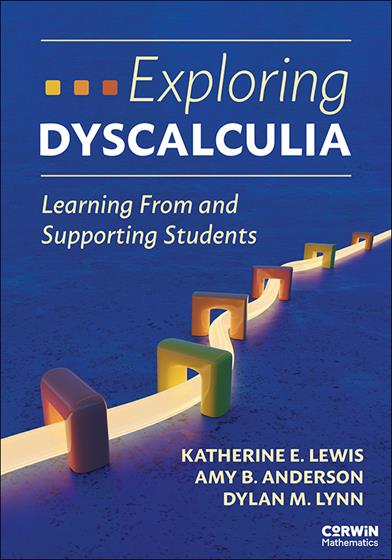
Exploring Dyscalculia: Learning From and Supporting Students
Support students with dyscalculia using anti-deficit strategies, real-world examples, assessments, and research-based practices for inclusive, strengths-based math instruction.
Unlock access to mathematics for students with dyscalculia by creating an inclusive environment where all your students can experience the joy of math!
Despite being as common as dyslexia, much less research has been done on dyscalculia (also known as a math learning disability). Many educators are unsure how best to support students with dyscalculia, particularly when these students have challenges with foundational number concepts. This groundbreaking book offers a fresh, assets-based perspective on students with dyscalculia with an in-depth exploration of their mathematical thinking.
Through detailed examples, this book guides educators in understanding how to look and listen for the access barriers students may encounter and how to provide meaningful supports to help students navigate around these barriers. By taking this mathematical journey with your students, you will uncover their unique strengths, support them in navigating through barriers, and help them unlock their mathematical potential.
Features include:
- Detailed vignettes illustrating the specific difficulties students face with quantities and symbolic notation
- Practical assessment tools, including clinical interviews, to truly understand your students' mathematical thinking
- Research-based instructional practices that blend student sense-making with vital access strategies
- Actionable guidance for partnering with families to support mathematics learning at home
By honoring neurodiversity through these practical strategies, you'll create an inclusive environment where all your students can experience the joy of mathematical success.
Table of Contents
Preface
About Language Choices
Overview of the Book
Acknowledgments
About the Authors
Students With Dyscalculia Featured in This Book
CHAPTER 1: What Is Dyscalculia? Welcome to the Inquiry
How Do You Tell If a Student Has Dyscalculia?
Co-occurrence With Other Disabilities
Research on Dyscalculia
Proposed Causes of Dyscalculia
Limitations of Dyscalculia Research
Beyond Causes: Learning From Students
Learning From Emily
Supporting Students
Exploring Dyscalculia Through the Details
Embarking on Your Own Exploration
Summary
CHAPTER 2: Difficulties When Quantities Are Inaccessible
Exploring Lisa’s Understanding of One-Half as Halving
Exploring Lisa’s Understanding of the Shaded Regions as “Taken”
Research on Number Processing Difficulties for Students With Dyscalculia
Research on Number Development: How Processes Become Objects
Inaccessible Quantities Across the Topic Domains
Understanding Whole Numbers as Processes
Understanding Negative Numbers as Processes
Understanding Unknowns in Algebra as Processes
Impact of Inaccessible Quantities
Incompatible and Inaccessible Representations of Quantities
Procedural Learning and Forgetting
Persistence of the Process Understandings
How to Listen for Quantities as Processes
Surprising Similarities in Some Students With Dyscalculia
How to Use the Fraction Assessment
Embarking on Your Own Exploration
Summary
CHAPTER 3: Difficulties When Symbolic Notation Is Inaccessible
Exploring Porter’s Use of Notation
Research on Symbolic Notation Difficulties for Students With Dyscalculia
Research on Mathematics Learning of Notation
Inaccessible Notation Across Topic Domains
Inaccessible Number Notation
Inaccessible Arithmetic Notation
Inaccessible Algebraic Notation
Impacts of Inaccessible Notation
Embarking on Your Own Exploration
Summary
CHAPTER 4: Assessing Dyscalculia Through a Clinical Interview
Exploring Porter’s Understanding
Understanding Porter’s Strengths
Tracing the Bounds of Porter’s Understanding
Understanding Difficulties as Inaccessibilities
What Is a Clinical Interview?
Why Conduct a Clinical Interview?
How Is a Clinical Interview Conducted?
Preparing for the Clinical Interview
Enacting the Clinical Interview
Analyzing the Clinical Interview
Embarking on Your Own Exploration
Summary
CHAPTER 5: Supporting Students With Dyscalculia With Access and Sense-Making Practices
Research-Based Approaches From Special Education and Mathematics Education
Access Practices
Reading All Text
Clarifying Conventions
Providing Tools and Manipulatives
Removing Time Constraints
Giving Students Choice
Simplifying Quantities
Encouraging Students to Offload Information
Sense-Making Practices
Adding Context
Directing to Tools
Orienting by Referring Back
Reflecting Questions
Validating and Reframing
Avoiding Derailment
Asking for Justification
Attending to the Big Idea
Access and Sense-Making Practices in Action
Supporting Luna in Grade-Level Mathematics
Supporting Evelyn’s IEP Goal: Fluency With Arithmetic Combinations
Embarking on Your Own Exploration
Unproductive Practices
Telling Students a Problem Is Easy
Pushing Students to the Abstract
Encouraging Efficiency
Defining Success as Completion
Removing the Cognitive Demand
Summary
CHAPTER 6: Creating Access to Quantities and Notation
Deliberate Inquiry and Problem-Solving
Creating Access to Quantities
Whole Numbers
Operations
Place Value
Fractions
Conclusion
Creating Access for Notation
Remembering Numbers
Differentiating Symbols
Connecting to Meaning
Consistent Processes
Inquiry and Problem-Solving to Create Access
Embarking on Your Own Exploration
Identify Inaccessibilities
Brainstorm Possible Tools and Approaches
Introduce the Tool or Approach
Evaluate the Effectiveness of the Tool or Approach
Games to Provide Support
Summary
CHAPTER 7: Embarking on Your Own Exploration of Dyscalculia
Select a Student for Exploration
Analyze Inaccessibilities
Center Student Access and Sense-Making
Iteratively Designing for Access
References
Index
Published: Aug 25, 2026
ISBN: 9798348808372
SKU: CP8372
Publisher: Corwin Press
Pairs well with
Exploring Dyscalculia: Learning From and Supporting Students
If you have any questions, you are always welcome to contact us. We'll get back to you as soon as possible, within 24 hours on weekdays.
-
Shipping Information
Use this text to answer questions in as much detail as possible for your customers.
-
Customer Support
Use this text to answer questions in as much detail as possible for your customers.
-
FAQ’s
Use this text to answer questions in as much detail as possible for your customers.
-
Contact Us
Use this text to answer questions in as much detail as possible for your customers.


FAQs
Please read our FAQs page to find out more.
How long does shipping take?
Standard delivery typically arrives within 3–7 business days depending on your location, and quantities ordered. Need books faster than a caffeinated teacher before finals week? Give us a call and we'll be happy to discuss meeting your deadlines.
Do you accept purchase orders from schools or districts?
Yes! QEP Books proudly supports school, district, and institutional purchase orders. Simply email your PO to QEPOrders@qepbooks.com and we'll take care of the rest.
Do you offer discounts for bulk orders?
Yes — the more books you buy, the happier we get, and the better your discount becomes. Reach out to our team for a custom bulk quote tailored to your school or organization.
Can I speak to a real human if I need help?
Absolutely. Our team is small but friendly, and actually reads your messages. Just use the contact form or email us directly at QEPOrders@qepbooks.com — we respond quickly and without AI-generated attitude.